How Austria's Rail Network Connects Alpine Passes to European Night Trains
Austria's railways unite Alpine pass routes with Europe's densest night train network. Understand how the Arlberg line and Wien Hauptbahnhof sleeper hub connect mountain valleys to distant capitals.
- Flag
-

- ISO code
- AT
- Population
- 8,847,037
- Currency
- EUR
- Dial code
- +43
The Railway That Does What Airlines Cannot
Night trains are not a romantic relic. They are the continent's most practical nocturnal junction, and the Arlberg and Semmering mountain passes are the reason. These alpine corridors, carved through rock in the 19th century, forced the railway to follow the steepest gradients in Europe. That same geography now positions Vienna as the hub for more than 20 sleeper routes, connecting Alpine valleys to cities from Brussels to Bucharest while you sleep. Understanding how the mountains shaped the rails tells you exactly which ticket to buy and which night train to board.
How Two Alpine Passes Built a Railway Network
The Semmering Pass and Its Viaducts
The Semmering line, completed in 1854, runs from Wiener Neustadt to Mürzzuschlag over the Semmering Pass. It was the first standard-gauge mountain railway in the world. UNESCO recognised it in 1998. The line climbs at a maximum gradient of 28 parts per thousand, and its summit tunnel sits at 898 metres above sea level. You do not need to ride the whole route to appreciate the engineering. Even the approach from Vienna gives you a sense of the terrain: the train slows, the curves tighten, and the viaducts stack above the treeline. Book a seat on an eastbound regional train in the late afternoon. You cross the pass just as the light drops into the valleys.
The Arlberg Pass and Its Tunnel
The Arlberg line, connecting Innsbruck to Bludenz, takes a different approach. Where the Semmering climbs via exposed viaducts, the Arlberg bores straight through the mountain. Its tunnel runs 10,648 metres, and the eastern ramp reaches a gradient of 31 parts per thousand. This is the line that carries the overnight sleeper trains from Zürich and the daytime Railjets from Munich down to the Austrian Alps. Board a sleeper from Zürich to Vienna and you enter the Arlberg tunnel around midnight. You wake in Vienna before 07:00. The tunnel saves you a full day of driving over the pass.
The Tauern Line as a Southern Connector
The Tauern line, between Schwarzach-St. Veit and Spittal-Millstättersee, cuts through an 8,371-metre tunnel under the Hohe Tauern range. This is the route that connects Salzburg to the southern Austrian states and onward to Italy. It is less famous than the Semmering or Arlberg but equally critical for night train routing. The sleeper from Vienna to Venice uses the Tauern tunnel. So does the connection from Munich to Rome. The gradient is gentler here, but the altitude still reaches above 1,200 metres at the tunnel portal. Pack a layer even in summer; the temperature drops noticeably inside the tunnel.


Vienna Hauptbahnhof: the Nocturnal Junction
Vienna Hauptbahnhof is the sleeper base for ÖBB, Austria's national railway. From this single station, more than 20 night train routes depart each evening. Within one night you can reach Berlin, Hamburg, Zürich, Rome, Venice, Milan, Paris, Brussels, Amsterdam, Warsaw, Kraków, Prague, Budapest, Bucharest, and Kyiv. That list covers nine countries from a single departure point. No other city in Europe offers this density of overnight connections. The practical implication is direct: book a room in Vienna for one night, and you can wake in a different capital each day for the next week without spending daylight hours in transit. A sample fortnight itinerary from Vienna by night train runs Vienna to Berlin, Berlin to Amsterdam, Amsterdam to Paris, Paris to Zürich, Zürich to Rome, Rome to Venice, Venice back to Vienna. Every border crossing happens while you sleep. Every morning you step into a new city with a full day ahead.
Which Ticket Gets You Across the Pass
You have two main options for crossing the Austrian Alps by rail, and the right one depends on your schedule and budget. The ÖBB Sparschiene advance fare from Vienna to Salzburg starts from €9.90 for the 2 hour 25 minute journey on the Westbahn corridor. The same route on a full-flex ticket costs approximately €55. That is a ratio of roughly 1 to 5.5. Book the Sparschiene at least two weeks ahead and you pay less than the price of a museum entry. Buy at the station on the day and you pay for a meal instead. The private operator WESTbahn runs the same corridor between Wien Westbahnhof and Salzburg Hbf for approximately €27 to €35, about 1.8 times the flexibility of the ÖBB full-flex fare. WESTbahn is walk-up friendly: no advance booking required, and the trains are newer. If you are travelling in a group of two to five people, buy the Einfach-Raus-Ticket. For €36 in 2026, it gives all of you unlimited travel for one day on all ÖBB regional trains, S-Bahn, R, and REX services. For each additional person up to five, add €4. The catch is the time restriction: Monday through Friday, validity starts at 09:00. On weekends, it runs from midnight. This ticket is perfect for cross-pass day trips to the Semmering or the Salzkammergut lakes.
The Vorteilscard Shortcut
If you plan more than two long-distance ÖBB journeys in a year, buy the ÖBB Vorteilscard Classic. It costs €66 for 2026 and gives you 50 percent off all domestic ÖBB tickets. A single round trip from Vienna to Salzburg at full price costs about €110. With the card, it costs €55. The card pays for itself on the second journey. Buy it online before you arrive and pick it up at a ticket machine in any Austrian station. Carry your passport; the card is personalised and conductors check ID.
The Night Train Tactic: How to Board, Sleep, and Disembark
Night trains save you hotel costs and travel time. They punish poor preparation. Board the sleeper at Vienna Hauptbahnhof no later than 21:00. Most departures leave between 20:30 and 22:30. Arrive 30 minutes early to find the correct platform and to buy food and water. The restaurant car closes early. There is no catering after midnight on most routes. Reserve a couchette, not a seat. A six-berth couchette costs roughly the same as a hostel bed, and you sleep horizontally. A seat in the open carriage guarantees a sleepless night and a ruined next day. Book your couchette through the ÖBB Nightjet website at least four weeks ahead during peak season, June through August, when school holidays push demand across Europe. The same logic applies to the return. Arrive in Brussels or Rome at 07:00 after a night on the train and you have a full day ahead. Plan nothing for the arrival morning except a coffee and a walk. The bed on the train is not a hotel bed. Do not schedule a museum visit before 11:00.
Moving With a Bicycle
If you are cycling the alpine passes, the railway is your partner. ÖBB Railjets carry a maximum of six bikes per train, and you must reserve a space. Regional trains carry bikes subject to space availability, no reservation needed. A bike day ticket on ÖBB costs €6 in 2026. On WESTbahn, the bike fee is €4.90 per day, and the train carries six bikes per service. Between May and September, book your bike space for any Railjet crossing the Arlberg or Tauern at least 48 hours ahead. The six spaces sell out on weekends. Skip the bike reservation and you may wait three hours for the next train with a free slot.

.jpg)
Who the Austrian Night‑Train Network Suits, and Who Should Skip It
The Austrian night‑train network is for the multi city hopper who treats a trip as a tasting menu of cultures and who values a full day in a new city over a comfortable night in a stationary bed. It is for the solo traveller who relies on dense public transport and hostel infrastructure, and for the history and art obsessive who plans trips around specific museum openings and will sleep on a moving train to wake at the museum door. It is for the food focused traveller who crosses borders for a single dish: a Sachertorte at Café Sacher in Vienna, a pastél de nata in Lisbon, a bougatsa in Athens. The night train from Vienna makes all of that possible without renting a car or booking a flight.
The Austrian night‑train network is not for anyone seeking a single unified cultural experience. Austria sits at a physical crossroads, but crossing into Hungary or Italy resets the language, the payment norms, and the social etiquette within a single morning. If you want digital convenience without friction, avoid Europe entirely or stick to the Netherlands and Estonia. If you want vast untouched wilderness, the Alps are densely layered with human settlement, cable cars, and resort towns. If you want tropical heat and all inclusive isolation, the Caribbean or Southeast Asia is a better bet. The night train is not a resort. It is a machine that moves you across geography while you sleep, and it rewards those who treat it as such.
Common Questions
How far ahead should I book a Nightjet couchette from Vienna?
Book at least four weeks ahead for peak season June through August. For shoulder months April, May, September, and October, two weeks ahead is usually enough. Routes to popular cities like Venice, Paris, and Amsterdam sell out first.
Can I use the Einfach-Raus-Ticket on Railjets or Nightjets?
No. The Einfach-Raus-Ticket is valid only on ÖBB regional trains, S-Bahn, R, and REX services. It does not cover Railjets, InterCity trains, or Nightjet sleeper services. For those, you need a separate ticket.
What is the cheapest way to travel from Vienna to Salzburg?
The ÖBB Sparschiene advance fare from €9.90 in 2026. Book at least two weeks ahead on the ÖBB website. The next cheapest option is the WESTbahn walk up fare at approximately €27 to €35.
Do I need to validate my ticket before boarding in Austria?
No. Unlike in Italy, France, or Switzerland, Austrian ticket machines do not require validation. Your ticket is valid from the moment you buy it for the date you selected. This trips up travellers arriving from other European countries who stamp a perfectly good ticket out of habit.
Which night train route gives the most scenic crossing of the Alps?
The sleeper from Vienna to Venice crosses the Tauern line and descends into the Drau valley at dawn. The Zurich to Vienna route crosses the Arlberg tunnel but the scenery is underground. For daytime viewing, ride the Semmering line on a regional train between 15:00 and 17:00 in summer.
Is the ÖBB Vorteilscard worth it for a 10 day trip?
Yes, if you take two or more long distance ÖBB journeys. A round trip Vienna to Salzburg costs €110 without the card, or €55 with it. The card costs €66. If you also travel Vienna to Innsbruck, the card saves you the full cost of the card plus more. For a single journey, skip it.
What happens if my night train is delayed and I miss my connection?
Sleeper connections are built into the timetable. If the delay is under 60 minutes, the station holds the connecting train in most cases. If the delay is longer, ÖBB rebooks you on the next service at no charge. Keep your ticket and ask station staff for a rebooking slip before boarding any alternative train.
Read next
-
 Austrian Rail and the Country That Brought Night Trains Back to Europe
Austria’s ÖBB bet big on night trains when the rest of Europe gave up. Here is how the Nightjet network works, from sleeper cabins to booking a berth out of Vienna.
Austrian Rail and the Country That Brought Night Trains Back to Europe
Austria’s ÖBB bet big on night trains when the rest of Europe gave up. Here is how the Nightjet network works, from sleeper cabins to booking a berth out of Vienna.
-
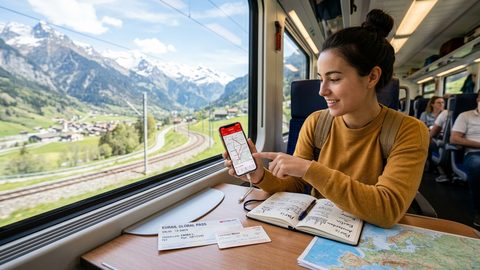 Planning a European Rail Trip Across Borders With Tickets and Mobile Data
Plan a cross-border European rail trip with clear advice on digital tickets, reservations, live departures, connections, and mobile data.
Planning a European Rail Trip Across Borders With Tickets and Mobile Data
Plan a cross-border European rail trip with clear advice on digital tickets, reservations, live departures, connections, and mobile data.