How Switzerland's Clockface Timetable Makes Every Connection Work
Switzerland's rail network operates on a synchronised clockface timetable that makes every connection deliberate. Learn how the Taktfahrplan system works and why you can trust a three-minute change.
- Flag
-

- ISO code
- CH
- Population
- 8,516,543
- Currency
- CHF
- Dial code
- +41
Switzerland by Rail: the Country the Timetable Built
Most travellers assume rail connections work by luck. You arrive at a station, check the departures board, and hope the connection lines up. That is not how Switzerland operates. The Swiss rail network works because departures repeat at the same minute past every hour across the entire country. An InterCity train leaves Zurich for Bern at four minutes past the hour. The PostBus in Visp leaves at 15 and 45 past. Every connection at every interchange is built around that rhythm. You walk off one train, cross the platform, and board the next in three to seven minutes. You can do it from Brig to Basel without checking a single schedule.
The system has a name: the Taktfahrplan, or clockface timetable. The Federal Office of Transport and Swiss Federal Railways jointly publish the annual timetable, updated each year on the second Sunday of December. The 2026 timetable holds. It is not a guidebook suggestion. It is the operating principle of the entire Swiss mobility machine. Once you understand that, you stop worrying about missing connections and start planning journeys that take you from a Zurich airport platform to a lakeside village in Graubünden inside a single morning.


How the Taktfahrplan Removes Uncertainty
The Pulse Of Every Departure
The clockface timetable means every train, PostBus, tram, and lake boat departs at a fixed minute each hour. On most Swiss Federal Railways intercity lines, departures cluster around the 00 and 30 minute marks. At Gotthard axis stations the pattern is tighter still. The minimum connection time at major stations is five to seven minutes. That is deliberate. At smaller rural junctions three minutes is enough. The platform is short and the crowd is small. You do not run. You step off, look across, and board.
The coordination extends beyond trains. PostBus services, scheduled lake boats on Lake Geneva, Lake Lucerne, and Lake Constance, and urban trams all synchronise with rail arrivals. The Swiss Travel System tickets and passes cover all three modes. Your Swiss Travel Pass gives you unlimited travel on SBB, most private railways, PostBus, and lake boats for 3, 4, 6, 8, or 15 consecutive days. The Swiss Travel Pass Flex does the same but spreads those days across a one-month window for CHF 30 more. The Swiss Half Fare Card cuts every rail, bus, and boat fare by 50 percent for one full year from purchase. If you are travelling with children aged 6 to 15, a Swiss Family Card makes them free.
Building Your Day Around Fixed Minutes
The practical effect: you can build a day around three segments and arrive at each destination at the same minute past the hour every time. A 08:04 departure from Zurich arrives in Bern at 08:58. The PostBus to the valley leaves at 09:15. You calculated that before you left the hotel. The timetable is not a suggestion. It is a contract.
What the Tickets Cost and What They Cover
Switzerland does not use cheap advance fares the way France or Spain does. SBB pricing is distance-based with degressive rates per kilometre. The standard fare from Zurich to Geneva is roughly CHF 90 one way. A Supersaver ticket for that same train, booked two weeks ahead, might drop to CHF 40. Saver Day Passes offer better value if you plan multiple legs. The 2026 price starts at CHF 29 with a Half Fare Card and CHF 52 without, rising to CHF 106 or more based on demand. Buy the day pass early. The price climbs as the date approaches.
The Swiss Travel Pass eliminates per-ticket stress entirely. A three-consecutive-day second-class pass covers the Glacier Express route without a fare, but the seat reservation costs CHF 39. The Bernina Express and the Gotthard Panorama Express each require a mandatory reservation supplement regardless of your pass. Do not expect to walk onto those trains without a booked seat; you will be turned away.
Mountain Railways And Pass Holders
The Swiss Travel Pass includes free travel on the Rigi, Stanserhorn, and Stoos mountain railways. For the Jungfrau, Gornergrat, Pilatus, Titlis, and Schilthorn, you get 50 percent off. The Half Fare Card also gives you 50 percent off every mountain railway. The Jungfrau Railway charges a supplement from Eigergletscher to Jungfraujoch that the Swiss Travel Pass covers at half price. The Gornergrat and Schilthorn runs apply the same 50 percent discount. If you plan to do two mountain excursions, the Swiss Travel Pass pays for itself on the cable car fees alone.
Reservations: The Crucial Difference Between Switzerland And Its Neighbours
Regular SBB intercity, regional, and local trains do not require reservations. You buy a ticket or activate a pass, board any train, sit anywhere. That is a relief after using France's TGV system, where a reservation is mandatory and selling out means not riding. Spain's AVE and Alvia services impose the same mandatory booking. Switzerland is the exception. You can change your mind at the platform, wait for the next hourly departure, and pay nothing extra. Reserve only the scenic expresses and mountain railways. Everything else is hop-on.


Who Should Use This System and Who Should Skip it
This timetable works for the traveller who wants to cover multiple valleys and cultural zones within a single trip. You can breakfast in French-speaking Montreux, lunch in German-speaking Zermatt, and reach Italian-speaking Lugano by evening. The clockface rhythm makes each leg predictable. It works for solo travellers who depend on dense public transport and hostel infrastructure. It works for multi-city hoppers who treat a trip as a tasting menu of regions. It works for anyone who hates wasting time on platforms.
It does not work for travellers seeking a single unified cultural experience. Switzerland is not one culture; it is four language regions and a fifth zone of remote mountain valleys. It does not suit beach-resort exclusivists who want tropical heat and all-inclusive isolation. Those travellers should choose the Caribbean or Southeast Asia. It does not suit anyone expecting vast, untouched wilderness at every turn. Much of Switzerland is densely layered with human settlement, cable cars, and cheese farms. The system is a machine for connecting those layers, not escaping them.
If you want to disappear into raw nature without a schedule, rent a car and skip the railway. But if you want to see four Alpine passes, two lakes, and a canton capital in one day and arrive at dinner without sweating the connection, this is the only timetable that delivers.
Common Questions
Do I need to validate my Swiss rail ticket before boarding?
Swiss tickets are valid for travel from the moment of purchase and do not require stamping. This differs from Italy, France, and Spain where an unstamped paper ticket earns a fine. Digital tickets on the SBB app are validated on purchase. Paper tickets for regional services are prevalidated. You board and go.
Can I use a Swiss Travel Pass on PostBus and lake boats?
Yes. The Swiss Travel System explicitly includes PostBus and scheduled lake boats on major lakes. Your pass covers Lake Geneva, Lake Lucerne, Lake Zurich, Lake Constance, and Lake Lugano services. Show the pass on boarding.
How do I book a seat on the Glacier Express?
You must reserve a seat separately from your ticket or pass. The reservation fee for 2026 is CHF 39. Book it on the Glacier Express official website or at an SBB ticket counter. Do this at least two weeks ahead in summer. The train does sell out.
How early should I arrive at the station for a connection?
For a standard SBB intercity connection, arrive on the platform two minutes before departure. The clockface timetable ensures your incoming train arrives at a minimum of five to seven minutes before the outgoing train at major stations. Three minutes is enough at rural junctions.
What happens if I miss my connection?
Regular SBB trains do not require reservations. Wait for the next departure, normally 30 or 60 minutes later depending on the line. The clockface pattern means the same minute past the hour repeats. Your existing ticket or pass remains valid.
Is the Swiss Half Fare Card worth it for a short trip?
A Half Fare Card costs CHF 190 for one year. If you plan two significant journeys, such as Zurich to Geneva and Zurich to Zermatt, the Half Fare Card saves money on the standard fare and gives you 50 percent off mountain railways. Calculate your total itinerary mileage before deciding.
Do children travel free?
Children under 6 travel free on all Swiss public transport without a ticket. Children aged 6 to 15 travel free with a Swiss Family Card when accompanying a parent who holds a Swiss Travel Pass or a Half Fare Card. The Family Card is free and issued when you purchase the parent pass.
Read next
-
 Swiss Rail and the Timetable That Actually Works Every Time
Switzerland’s rail network runs on a clockface timetable where connections are guaranteed. Compare the Swiss Travel Pass and Half Fare Card, and learn how the system works.
Swiss Rail and the Timetable That Actually Works Every Time
Switzerland’s rail network runs on a clockface timetable where connections are guaranteed. Compare the Swiss Travel Pass and Half Fare Card, and learn how the system works.
-
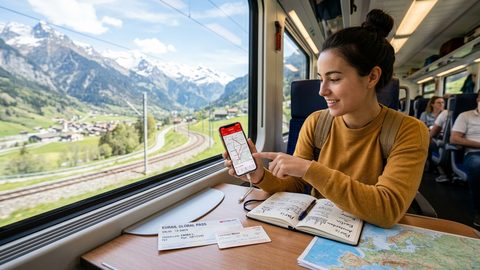 Planning a European Rail Trip Across Borders With Tickets and Mobile Data
Plan a cross-border European rail trip with clear advice on digital tickets, reservations, live departures, connections, and mobile data.
Planning a European Rail Trip Across Borders With Tickets and Mobile Data
Plan a cross-border European rail trip with clear advice on digital tickets, reservations, live departures, connections, and mobile data.