How to Navigate Italy's Rail Network Beyond the High-Speed Spine
Italy's rail network is more than the Frecciarossa spine. Discover the regional branch lines that climb through the Apennines and hug the Sicilian coast, and why they are worth the slower pace.
- Flag
-

- ISO code
- IT
- Population
- 60,431,283
- Currency
- EUR
- Dial code
- +39
The Porrettana and Italy’s Regional Branch Lines
The train stops at a station that is not a station. Porretta Terme has a stone waiting room, a bar that opens when the barista feels like it, and a platform looking out onto a river gorge. The fast train from Milan to Florence passes somewhere under the mountain, thirty kilometres away. You are on the old line, the Porrettana, and the windows are open because the carriage has no air conditioning. That is the point.
Most guides fixate on the Frecciarossa spine between Milan, Florence, Rome, and Naples. That spine is fast and it works. The fastest service covers the 700 kilometres from Milano Centrale to Salerno in about four and a half hours, touching 300 km/h on the straight stretches. But the real Italy, the one that still runs on cash and closes for lunch and stacks plates onto checkered tablecloths, sits on the branch lines. The regional trains are worth the time penalty, and some routes deserve skipping the fast lane to ride.


The High-Speed Spine: What You Sacrifice for Speed
The spine connects Torino Porta Nuova, Milano Centrale, Bologna, Firenze, Roma Termini, and Napoli Centrale. Book a Super Economy fare on Trenitalia Frecce, roughly 50 to 60 percent of the Base fare, and you ride Milano to Roma in 2 hours 45 minutes. Roma to Napoli takes 1 hour 10 minutes. Napoli to Salerno takes 35 minutes. Torino to Milano takes 45 minutes. These trains demand a reservation, included in your ticket. They run on a timetable that shifts twice per year: the second Sunday in June and the second Sunday in December.
What you miss: the Apennines. The spine bores through them in tunnels. You arrive in Florence having seen nothing but a black wall and the occasional flash of a valley. You swap landscape for speed. That trade is correct for a two-city trip. It is wrong when you have time to take the old road.
The Branch Lines Worth the Longer Ride
Three routes justify abandoning the high-speed network. Each costs you time. Each pays you back in place.
The Porrettana: Bologna to Pistoia via the Apennines
The old Bologna, Pistoia line climbs through the Apennines on a route that opened in 1864. It is a regional train: fixed price per kilometre band, no reservation possible, open seating. Buy your ticket at the machine, validate it before boarding or risk a fine, and sit in a car that rattles through tunnels built by hand. The line crosses the Tuscan-Emilian Apennines at Pistoia and drops into Tuscany. The trip takes about double the time of the high-speed Bologna, Florence run. The views of the Reno Valley and the limestone gorges around Porretta Terme are the compensation. Ride it westbound in the afternoon for light that catches the stone villages on the northern slope.
Cinque Terre: Genova to La Spezia
The Ferrovia Genova, Pisa runs along the Ligurian coast and serves the five villages of Cinque Terre: Monterosso, Vernazza, Corniglia, Manarola, and Riomaggiore. Every guide mentions it. Few explain that the regional train is the only sensible way to move between the villages. The hiking trails close for maintenance. The roads are one-lane cliffs. The train runs every 30 minutes in season, costs a few euros per hop, and deposits you at the village station. Buy a Cinque Terre Treno Card at La Spezia or Levanto if you plan to ride multiple segments in a day. Skip the ferry. It is slow, expensive, and cancelled in rough weather.
Sicily Coastal Lines: Messina to Palermo and Messina to Siracusa
Sicily operates two coastal main lines. The Tyrrhenian line runs Messina to Palermo along the north coast. The Ionian line runs Messina to Catania to Siracusa along the east coast. Neither is high speed. Both are regional and InterCity services operated by Trenitalia. The trains are older. The air conditioning fails. The timetable is a suggestion. The reward is the coast: the Tyrrhenian side passes the Aeolian Islands across the water; the Ionian side runs past the volcano at Etna. To get your train onto the island, you ride a ferry across the Strait of Messina. The train rolls onto the boat at Villa San Giovanni, crosses in about 30 minutes, and disembarks at Messina Marittima. RFI and Bluferries operate the ferries. Stand on the deck during the crossing, not in the carriage.
The Circumvesuviana: Napoli to Sorrento and Pompeii
The Circumvesuviana is not a regional train in the Trenitalia sense. It is a commuter network operated by EAV (Ente Autonomo Volturno). It does not validate tickets the same way. It does not run on time. It does not have air conditioning. You need it anyway. The Napoli, Sorrento line leaves from Napoli Porta Nolana and Napoli Garibaldi and runs past Pompeii, Herculaneum, and down the Sorrentine Peninsula. The Napoli, Pompei, Poggiomarino line reaches the Vesuvius area. Use it to reach Pompeii faster than the high-speed connection, but budget for the crush of a commuter train in summer. A fine for an unvalidated ticket is not theoretical on this line: inspectors board between stations regularly.
When the Train is the Wrong Choice
Buses beat trains in Basilicata, Calabria, inland Sicilia, and inland Sardegna. The regional transport plans and ISTAT mobility data from 2023 confirm it: network coverage and frequency are better on four wheels than on rails in those areas. If your itinerary includes Matera, the interior of Calabria, or the hill towns of inland Sicily, book a bus. The same applies to much of rural southern Italy: Campania, Puglia, and Calabria interiore have routes where a bus runs three times a day and the train runs once, if it runs at all.
Do not attempt to cover five cities in ten days. That is the most common mistake on the Italian rail network. You spend the trip in stations and security queues, not in the places. Budget a minimum of 10 days for a meaningful tour, and even then, pick three bases: one on the spine (Florence or Rome), one on a branch (the Cinque Terre or Sorrento), and one island stop (Palermo or Catania). Anything less and you are burning two days in transit and jet lag.


The Fare Game: How to Pay Less on the Spine
High-speed fares on Trenitalia Frecce split into three bands. Base is the full price, flexible and refundable. Economy cuts the Base fare to roughly 70 to 80 percent but locks you to the train. Super Economy drops to 50 to 60 percent of Base, non-refundable and train-locked. Italo offers the same structure: Flex (full price), Economy (70 to 80 percent), and Low Cost (50 to 60 percent). Book Super Economy or Low Cost at least two weeks ahead to secure the bottom price. The 2025 fare structures published by the operators confirm these ratios, but the exact price varies by route and departure date. Do not buy a third-party bundle that adds fees. Buy directly from the operator.
Logistics That Trip First-Timers
Arrive at Milano Centrale from Malpensa via the Malpensa Express: 50 minutes, €13. From Roma Termini, the Leonardo Express from Fiumicino runs 32 minutes, €14. Validate your ticket before boarding. The ticket machines at each station have a different interface. That is the test. Carry coins for public toilets: €0.50 to €1.50. Tap water is not free in restaurants; you pay for bottled unless you ask for tap water explicitly. Strikes affecting trains and metros are a seasonal reality in Italy, especially in May, June, and September. Check the union calendar before you book transport.
EU roaming is free for EU SIMs. UK and Swiss SIMs are not covered. You will rack up charges if you cross from Italy into Switzerland for a day trip to Lugano without a plan. Buy a regional eSIM before departure; public WiFi often requires SMS verification that will not work on a foreign number.
Who Regional Branch Lines Suit and Who Should Stick to High-Speed
Regional branch lines suit the traveller with 10 days or more who wants to see the part of Italy that does not appear on a high-speed timetable. They suit the person willing to lose two hours of speed to gain a landscape, a station bar, and a coastline. They suit the traveller who knows that the spine gets you there and the branch lines tell you where you are.
They do not suit the multi-city hopper on a seven-day blitz. They do not suit the traveller who needs frictionless digital convenience and finds regional train validation stressful. They do not suit anyone who wants only beach resorts and all-inclusive isolation. That traveller should look to the Caribbean or Southeast Asia. Italy rewards the slower commitment.
Common Questions
Do I need a reservation for regional trains in Italy?
No. Trenitalia Regionale operates open seating with no reservation. Buy a fixed-price ticket per kilometre, validate it at the green machine before boarding, and sit anywhere. Frecce and InterCity trains require a reservation, included in the ticket price.
Can I use the same app for all Italian trains?
No. Trenitalia and Italo each have their own app. Regional transit in cities like Naples and Palermo needs separate apps. Paper tickets still work but you must validate them before boarding or you risk a fine equal to the ticket price.
Which branch line is best for a day trip from Rome?
None of these. The branch lines described start from Bologna, Genova, Napoli, and Messina. From Rome, take a high-speed train to Napoli (1 h 10 min) and then the Circumvesuviana to Pompeii or Sorrento. That is a full day.
When should I avoid Italian trains entirely?
August. Many locals take holiday, family-run shops close, and packed beaches make regional trains uncomfortable. Also avoid the week between Christmas and New Year when timetables thin out. Easter week floods Rome with pilgrims and drives up fares.
Read next
-
 Italian Rail Without the Chaos: Trenitalia, Italo and the Regional Network
Italy’s rail system splits between Trenitalia and Italo, and forgetting to validate a regional ticket can cost you. Here is how to ride Italian trains without the fines.
Italian Rail Without the Chaos: Trenitalia, Italo and the Regional Network
Italy’s rail system splits between Trenitalia and Italo, and forgetting to validate a regional ticket can cost you. Here is how to ride Italian trains without the fines.
-
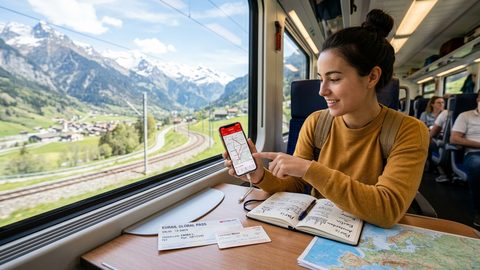 Planning a European Rail Trip Across Borders With Tickets and Mobile Data
Plan a cross-border European rail trip with clear advice on digital tickets, reservations, live departures, connections, and mobile data.
Planning a European Rail Trip Across Borders With Tickets and Mobile Data
Plan a cross-border European rail trip with clear advice on digital tickets, reservations, live departures, connections, and mobile data.