How to Use the Dutch Rail Network When Every City Is Next Door
The Dutch rail network runs with metro-like frequency across the Randstad. Learn how to treat the Netherlands as a single-base, multi-city day-trip circuit rather than a point-to-point journey.
- Flag
-

- ISO code
- NL
- Population
- 17,231,017
- Currency
- EUR
- Dial code
- +31
How to Use the Dutch Rail Network When Every City is Next Door
The train doors close at Amsterdam Centraal. Eight minutes later, you are standing on the platform in Utrecht, coffee still warm. That is not a special express. That is the standard off-peak interval on one of Europe's densest rail corridors. In the Netherlands, the line between intercity and metro does not exist. The network runs like a subway scaled to a country. Amsterdam to Utrecht departs every 10 minutes. Rotterdam to The Hague, every 10 minutes. No domestic journey between any two stops exceeds two hours. That rewires how you plan a trip.
Elsewhere in Europe, rail travel means working around a handful of departures. You check the timetable before you book. A day trip feels like a morning-long commitment. Here, you do not plan around the train. The train plans around you. Base yourself in one city and day trip to five others without a single early alarm. The question is never whether the train runs. It is which platform, and whether you remembered to check out with your OV-chipkaart when you arrived.


The Network as a National Metro
What This Means for Your Itinerary
Sleep in. Plan your first stop for 10:00 and still fit four cities into a day. Start in Amsterdam for the morning at the Rijksmuseum. Take the 14-minute intercity to Haarlem for lunch. Roll into Leiden for an afternoon at the Hortus Botanicus. Finish in The Hague for an early dinner. Every leg runs on a schedule where the next departure is never more than 15 minutes away. Miss one, wait for the next. No penalty. No wasted time.
The Only Ticket System You Need to Understand
What About the Bicycle?
The OV-fiets scheme lets you rent a bicycle from roughly 300 locations across the country. The 2026 rate is €4.55 per 24 hours, capped at 72 hours per bike. Tap your OV-chipkaart and the bike releases. This is the fastest way to cover the last kilometre between the platform and your actual destination, especially where tram routes require a transfer. Grab a bike at the stop, ride to the museum or café, return it to a different stop. The system expects exactly that.
Crossing Borders Without Losing the Rhythm
The One Thing That Trips Everyone Up
Domestic trains allow bicycles outside peak hours: 09:00 to 16:00 and 18:30 to 06:30, plus all day on weekends and public holidays. The bike ticket costs €7.50 per day (2026 NS Fietskaart Dal). Cross-border ICE trains do not permit bicycles at all. The Intercity Direct to Brussels allows them but spaces are limited and you need an international bike ticket. Rent an OV-fiets and then try to take it to Antwerp? You will be turned away at the platform.

.jpg)
| Destination | Time | Frequency | Reason To Go |
|---|---|---|---|
| Utrecht | 14-18 min | Every 10 min | Rietveld Schröder House, Dom Tower, canal-side terraces |
| Haarlem | 14-19 min | Every 15 min | Frans Hals Museum, Grote Markt, quiet streets |
| Leiden | 22-30 min | Every 15 min | Hortus Botanicus, Museum of Antiquities, student cafes |
| The Hague | 35-45 min | Every 15 min | Mauritshuis, Peace Palace, Scheveningen beach |
| Rotterdam | 40-50 min | Every 15 min | Markthal, Cube Houses, harbour tour |
| Delft | 45-55 min | Every 15 min | Vermeer Centre, Royal Delft pottery, canals without cruise-ship crowds |
The Practical Next Step
Open the NS app on your phone. Do it before you book accommodation. Enter Amsterdam Centraal as your origin, then search for Utrecht, Rotterdam, or Haarlem. Watch the departure list populate with times every few minutes. That screen is your mental model for the entire country. The train does not constrain your itinerary. It dissolves the distance between cities. Book a hotel near a central stop, load an anonymous OV-chipkaart with €40, and treat every Dutch city as a metro stop. One base, five day trips, zero wasted mornings.
Common Questions
Can I use the same OV-chipkaart for the train and the tram?
Yes. The card works on all public transport modes nationwide. Tap on and off for each mode. Switch from train to tram? Check out of the rail stop and check in at the tram stop. The system calculates each leg separately.
What happens if I tap in at the wrong pole or tap out at the wrong station?
Check-in and check-out poles sit at entrances and on platforms. Tap in but leave without tapping out, and the system deducts a fixed penalty from your balance. Tap out at a different stop than your destination, and it charges the fare to that stop. Always tap out at your actual exit point.
Is it cheaper to buy a day ticket or a single ticket for multiple trips?
For most travellers, the anonymous OV-chipkaart with pay-per-tap is cheapest if you make fewer than four rail journeys in a day. A day return costs 80% more than a single. Planning three or more trips? Consider the NS Day Ticket, available at ticket machines, valid for unlimited domestic travel on one calendar day. The price fluctuates seasonally but beats four singles.
Do I need a reservation for domestic trains?
No. Domestic NS trains require no reservation on any route. Buy a ticket, tap in, board any departure. Seats are unreserved. During peak hours, the corridor trains between Amsterdam, Utrecht, and Rotterdam can be standing room only.
How does the Schiphol airport train station work?
Schiphol sits directly beneath the terminal. Find it between Schiphol Plaza and the departure halls. Ticket machines are near the escalators. Trains to Amsterdam Centraal depart 6 to 10 times per hour (2026 NS timetable) and take 14 to 18 minutes. The hub also hosts intercity services to Rotterdam, The Hague, and Utrecht. Reach almost any Dutch city from Schiphol with one transfer or fewer.
What is the minimum balance requirement for train travel?
For an anonymous OV-chipkaart, you need at least €20 loaded before you can tap in for train travel (2026 NS policy). For a personal card with auto top-up, the minimum is €10. Local tram and bus require a lower minimum, usually €5. Load extra for a long journey. The system deducts the full fare at check in and refunds the balance at check out.
Can I take a bicycle on the train for a day trip?
Yes, outside peak hours (09:00-16:00 and 18:30-06:30) and all day on weekends and public holidays. You need a Fietskaart Dal ticket, which costs €7.50 per bike per day (2026 NS rate). Bicycles are not permitted on cross-border ICE trains and have limited spaces on the Intercity Direct to Brussels.
Read next
-
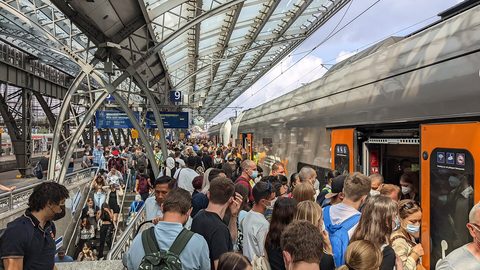 Dutch Rail Made Simple: NS, the OV-chipkaart and Taking Your Bike on Board
The Netherlands runs on the OV-chipkaart, and bringing a bike on board has its own set of rules. Here is how NS trains work from Schiphol to Centraal and beyond.
Dutch Rail Made Simple: NS, the OV-chipkaart and Taking Your Bike on Board
The Netherlands runs on the OV-chipkaart, and bringing a bike on board has its own set of rules. Here is how NS trains work from Schiphol to Centraal and beyond.
-
 Planning a European Rail Trip Across Borders With Tickets and Mobile Data
Plan a cross-border European rail trip with clear advice on digital tickets, reservations, live departures, connections, and mobile data.
Planning a European Rail Trip Across Borders With Tickets and Mobile Data
Plan a cross-border European rail trip with clear advice on digital tickets, reservations, live departures, connections, and mobile data.