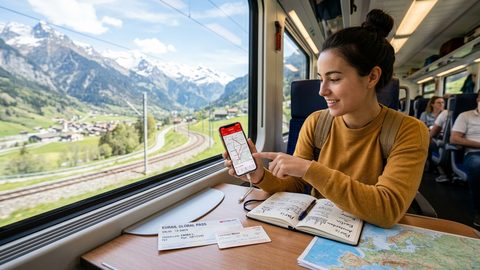
How Portugal's Rail Network Divides Into Three Distinct Travel Experiences
Portugal's rail network splits into three distinct experiences: the scenic Douro line, the coastal Algarve route, and the slow Alentejo interior. Choose the corridor that fits your travel temperament.
- Flag
-

- ISO code
- PT
- Population
- 10,281,762
- Currency
- EUR
- Dial code
- +351
Portugal by Rail: the Douro Line, the Coast and the Slow Interior
Most travellers assume Portugal's rail network is one smooth system connecting every town on a single national grid. It is not.
Comboios de Portugal runs three distinct lines that barely talk to one another. The Douro Line from Porto to Pocinho is a tourist magnet, a slow ride through terraced vineyards that demand your attention. The Algarve Line along the south coast works as a pragmatic spine for beach hoppers, moving you from Lagos to Vila Real de Santo António with decent frequency and few surprises. And then there is the Alentejo interior, where Lisbon sends a few Intercidades trains per day toward Évora and Beja, and where the old branch lines have been replaced by regional buses that feel like time travel. Each route has a different rhythm, a different rolling stock, and a different kind of traveller it suits. Pick the wrong one and you spend your holiday waiting on a remote platform for a train that comes twice a day.
The character of each route maps onto a different temperament, with honest expectations about what you will find on board. You will not find a single Portuguese railway app or a unified timetable. You will find three separate decisions about how much of your day you want to give to the tracks.

The Douro Line: the Tourist Route That Delivers What it Promises
What to Expect on Board
Porto Campanhã to Pocinho, 3 hours 25 to 3 hours 35 minutes end to end. Five to six trains daily in each direction in 2026. That is not a high frequency. Miss the 09:00 and you wait until after lunch. But the Douro Line earns its reputation on the section from Pinhão to Pocinho, where the railway clings to the river gorge and the view shifts from vineyard terrace to vineyard terrace without a break. The rolling stock is regional class, meaning no mandatory reservation, no dining car, no air conditioning you can count on in August. You sit on hard seats with a window that opens. That is the experience. Bring water, bring food, bring a hat.
How to Plan Your Day
Book the train leaving Porto by 09:00 if you want to reach Pinhão by late morning and spend time walking the town before catching the afternoon service onward to Pocinho. Do not expect a scenic commentary or a glass of port on board. The wine tourism happens at the stations, not on the train. If you want the full Douro valley experience without driving, take the regional train one way and a boat or organised tour back. That gives you the rail perspective through the gorge and a different angle from the river.
The route serves one clear audience: travellers with a full day to spare who want the Douro valley as a destination, not a backdrop. If you are trying to do Porto and the Douro in a long weekend, the train is too slow. Pay for a private driver or a small-group tour instead. The railway does not bend to your schedule.
The Coastal Route: Lisbon to Faro and the Algarve Line
The Pragmatic Spine
This is the pragmatic line. The Algarve Line runs Lagos to Vila Real de Santo António in 3 hours 30 to 3 hours 45 minutes, with 8 to 10 trains per day between Lagos and Faro in each direction in 2026. That frequency makes it the only Portuguese rail route where you can reasonably hop between towns without a printed schedule. You miss a train, you wait an hour, not four.
Do not confuse this with a scenic coastal railway. Most of the track runs a few hundred metres inland behind the dunes. You see scrub, some eucalyptus, the occasional glimpse of sea. The value is purely practical: it drops you in the centre of every Algarve town with a station, which means you avoid the taxi cost from Faro airport to your resort. Lagos, Portimão, Albufeira, Faro, Tavira all have stations within walking distance of the old towns. The trains are regional class, reservation not possible, no dining. Pack your beach bag like you would for a city metro.
Who It Suits and Who It Does Not
The route works best for multi-stop travellers who want to spend three nights in Lagos, two in Tavira, and skip car rental entirely. It fails for anyone staying in a cliffside resort east of Olhão or west of Sagres. The bus from Lagos to Sagres, operated by Rede Expressos, covers that last gap. The train does not go there and never will.

The Slow Interior: Alentejo and the Lines That Fade
The Reality of Inland Rail
Lisbon to Évora takes 1 hour 30 to 1 hour 45 minutes on the Intercidades, with 3 to 4 trains per day in each direction in 2026. That is the high end of the interior experience. For Beja, the frequency is lower and the rolling stock older. For the abandoned branches like the Ramal de Moura from Beja to Moura, or the Ramal de Reguengos from Évora to Reguengos de Monsaraz, the rails are gone. Rodoviária do Alentejo runs buses on those routes. You stand at a bus stop on a two-lane road and hope the driver sees you.
This line does not deliver efficiency. It delivers silence, emptiness, and the sensation that you have stepped into a Portugal the guidebooks forgot. The landscape is flat wheat plains, cork oak groves, whitewashed villages with one café and a church. The train stations, where they still operate, are unmanned. You buy your ticket from a machine or on your phone or, if the machine is broken, from the conductor with cash. Carry coins. The card reader may not work.
Who Should Ride, Who Should Skip
Who should ride this line? Solo travellers who want to read a book through a window for two hours. History travellers who want to see the Roman temple in Évora and the castle in Beja without a tour group. Anyone who finds high season unbearable and prefers a March or October visit when the trains run empty. Who should skip it? Any traveller on a tight schedule who needs to be somewhere by lunch. Any family with young children and no car. Any traveller who panics when a train does not show up on the dot.
The practical move is to plan your Alentejo visit around Évora as a base, using the Lisbon Évora Intercidades as your main connection and the local buses for day trips. Do not attempt to connect Évora and Beja by rail on the same day unless you have checked the 2026 timetable and confirmed the connection exists. The trains do not coordinate with each other.
Fares, Cards and the Harder Truth
Across all three routes, the same rules apply. Alfa Pendular and Intercidades trains require mandatory reservations. Buy Promo tickets at least five days ahead for a 40% to 70% discount off the full flexible fare. The 2026 Alfa Pendular Turística Promo fare from Lisbon to Porto runs €9.50 to €22.00; the Conforto Promo is €14.00 to €28.00. If you buy at the station on the day of travel, you pay the full flexible rate, €30.00 to €42.00 in Turística, €40.00 to €55.00 in Conforto. The difference is the price of a hotel night. Book in advance.
If you are 12 to 25, or under 30 with valid student status, apply for the Cartão Jovem at a CP station and get 25% off flexible fares. If you are 65 or over, the Cartão Sénior cuts flexible fares by half. These cards pay for themselves on a single long journey. Apply in Portugal, not online. The system expects you in person.
The harder truth is that Portugal's rail network, even at its best, does not run like Germany's or Switzerland's. Trains are late. Timetables change annually in December and get a summer supplement. Strikes happen. The CP website in 2026 still has sections that do not translate into English. You navigate it with patience, with cash, and with a printed backup timetable. If that sounds like friction you would rather avoid, stay on the Algarve Line where the frequency absorbs the delays. If it sounds like part of the experience, buy a ticket to Pocinho and watch the river bend through a window that opens.
Common Questions
Which Portuguese rail route is best for a first time visitor with limited time?
The coastal Algarve Line from Lagos to Vila Real de Santo António. It has the highest frequency, 8 to 10 trains daily between Lagos and Faro, and the stations sit in town centres. You can miss a train and catch the next one within an hour. The Douro Line and Alentejo interior punish missed connections with multi hour waits.
Can I ride the Douro Line and return to Porto in the same day?
Yes, but you need the first departure from Porto Campanhã, around 09:00, and the last return from Pocinho. The end to end journey takes 3 hours 25 to 3 hours 35 minutes each way. That leaves roughly two hours at the far end. Do not attempt a lunch reservation in Pinhão and a return the same day.
Why are regional buses replacing trains in the Alentejo interior?
CP closed several loss making branch lines, including the Ramal de Moura, Ramal de Reguengos, and Ramal de Montemor. Rodoviária do Alentejo and Rede Expressos now run buses on those routes. The bus schedule is thinner than the train schedule was. Check departure times two days ahead, not at the station.
How do I pay for a train if the ticket machine is broken in rural Portugal?
Carry €5, €10, and €20 notes plus coin change. Regional trains without mandatory reservation allow you to buy from the conductor if the station machine is out of order. The conductor carries a card machine but it may not accept foreign cards. Cash is the universal fallback everywhere outside Lisbon and Porto.