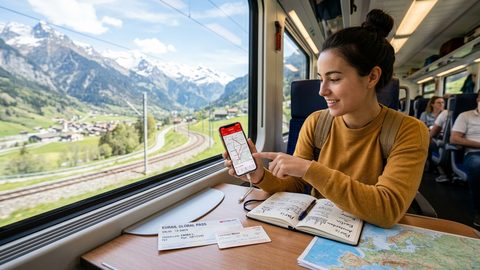
How Switzerland Built a Rail Network Where Everything Connects
Switzerland’s rail network runs on a clockface timetable where connections are guaranteed. Compare the Swiss Travel Pass and Half Fare Card, and learn how the system works.
A Train in Zermatt, Where the Car Stops and the Clock Rules
The electric motor cuts out as the train glides into Zermatt station. No engine noise. No idling taxis. This is the end of the road, literally: the town banned private cars in 1961, and the only way in or out is by rail. That is the first lesson in Swiss train travel. The network was designed from the start as the only option, not a backup to driving. The result is a system that operates with a precision that makes the rest of Europe look improvised.
Every major station in Switzerland runs on a clockface timetable. Trains depart at 00 and 30 minutes past each hour. The connection window between routes is a tight five to seven minutes. You step off one train, walk to the next platform, and board. The system assumes you will make it, because the system is built for that. It works because the SBB, RhB, MOB, and BLS networks coordinate their schedules around that same half-hour pulse. Post buses, lake boats across five different operators, and mountain funiculars all feed into the same rhythm. Miss a connection? Unlikely. But if you do, the next one is exactly 60 minutes away, unless it is a commuter line, in which case it is 30.

The Clockface Timetable is the Foundation, Not a Feature
The Swiss do not treat punctuality as a goal. They treat it as a mathematical requirement. Because the network is integrated, a ten-second delay in Zurich can cause a missed connection in a mountain village 200 km away. The standard departure symmetry, minutes 00 and 30, means that a traveller arriving at a major station at 14:07 never waits longer than 23 minutes for the next departure in any direction. That is the result of a national policy, not a cultural quirk. The SBB updates its timetable data weekly through an open platform, and the entire schedule shifts on the second Sunday of December each year. Nothing is left to drift.
For you, this reliability removes the single biggest stress of European rail travel: the anxiety of whether the connection holds. In France or Italy, a delayed regional train can collapse an afternoon plan. In Switzerland, the timetable does not lie. The Glacier Express from Zermatt to St. Moritz runs with the same clockface discipline as the suburban S-Bahn out of Zurich. The GoldenPass Express from Montreux to Interlaken crosses three private railway companies, and the whole journey is ticketed as one product. The system trusts itself, and you can too.
Swiss Travel Pass or Half Fare Card: What You Actually Pay for
Swiss Travel Pass: The All-In Option
Two passes dominate the conversation, and picking wrong costs you hundreds of francs. Here is the breakdown based on 2026 published fares from Alliance SwissPass and SBB Tarifverbund.
The Swiss Travel Pass is an all-you-can-ride pass for consecutive days. The 3-day second class pass costs CHF 244. The 4-day pass is CHF 295. The 8-day is CHF 419. The 15-day is CHF 459. It covers every train, bus, boat, and urban tram in 90 towns. It also covers entry to 500 museums. Travellers under 25 get a 30% discount. Buy this pass if your trip involves at least four long-distance train days, plus museums and lake boats. Skip it if you buy the 3-day pass but spend two days hiking and skip the museums. You paid for coverage you did not use.
Half Fare Card: Pay As You Go, Half Price
The Half Fare Card costs CHF 190 for the first year, CHF 170 on renewal. It gives 50% off every ticket on the SBB, RhB, MOB, BLS, PostBus, and lake boats. For a visitor staying 10 to 15 days, this works better than the Travel Pass only if you take fewer than three long-distance train days. Consider the Saver Day Pass: with a Half Fare Card, a Saver Day Pass starts at CHF 29 for a full day of unlimited travel, purchased up to 60 days ahead, and rises to CHF 88 as the date approaches. Without the Half Fare Card, the same Saver Day Pass ranges from CHF 52 to CHF 128. A traveller doing four single big journeys, for example Zurich to Zermatt and back plus two shorter cross-country routes, will spend less by buying the Half Fare Card plus four Saver Day Passes than by buying an 8-day Swiss Travel Pass. Run the numbers on the SBB Mobile app before you buy either.
| Option | Cost (CHF, 2nd Class, 2026) | Best For |
|---|---|---|
| Swiss Travel Pass 8-Day | 419 | 4+ long train days, many museum entries, lake cruises |
| Half Fare Card + 4 Saver Day Passes (low band) | 190 + 4 x 29 = 306 | 2-3 long train days, no museum dependence |
| Half Fare Card + 4 Saver Day Passes (high band) | 190 + 4 x 88 = 542 | Same but bought late, worse than Travel Pass |
| Half Fare Card + standard half-price tickets | 190 + per-trip cost | 1-2 train journeys, mostly hiking or city days |

Zermatt Proves Why the System Matters
Arrive by Rail, Walk to Everything
Zermatt is the showcase, not an exception. Arrive by train and walk to your hotel. Every piece of freight from food to furniture moves on electric service vehicles. The car-free rule forces every visitor to use the rail network. The result is a town where the only noise is from river and glacier. Walk from the station to the Matterhorn viewing platform in minutes. Board the Gornergrat railway from the same station you arrived at. Catch the Glacier Express to St. Moritz from platform 3. Nothing requires a taxi, a rental car, or a ride-share app.
Beyond the Rails: PostBus and Lake Boats
The PostBus network extends this logic to places trains cannot reach. Ride the Furka Pass route to 2,503 metres, the highest altitude PostBus line in the country. Your Swiss Travel Pass or Half Fare Card covers that bus just like it covers the InterCity to Geneva. Lake boats on Lake Lucerne, Lake Zurich, Lake Geneva, Lake Thun, and Lake Biel are included too. The integration is not a marketing claim. It is a designed reality. Buy a single ticket in the SBB app and it covers your journey from the airport train station to the top of a mountain pass via two trains and a boat.
Who the Swiss Rail Network Suits and Who Should Skip It
Buy the Pass If This Is You
The Swiss rail network is for the traveller who wants a single, reliable transport spine for a trip: no car rental, no fragmented apps, no guessing whether the bus will show up. It suits first-time visitors to Switzerland who want to see the Matterhorn, Lake Geneva, and the Jungfrau without owning a vehicle. It also suits multi-city hoppers arriving by train from Milan, Paris, or Munich who expect the same standards to hold.
Skip the Pass If This Is You
Do not buy a rail pass if you want to rent a car for spontaneous detours into remote valleys the buses do not reach. The car-free policy in Zermatt is a feature for most travellers, but a dealbreaker for drivers who want to sleep in a mountain hut that requires a 4x4 track. Skip it too if you want a single resort and no transport decisions. Switzerland is a rail country, and the rail country makes demands: you plan around the timetable, not the other way around.
The One Mistake That Costs You
The single thing that goes wrong most often for visitors is failing to understand that the Swiss Travel Pass and the Half Fare Card serve different trip profiles. Buying the wrong one wastes money. If your trip has four or more days of long-distance train travel and you plan to visit museums, buy the Swiss Travel Pass. If your trip has two long-distance days and the rest is city walking or hiking, buy the Half Fare Card and buy Saver Day Passes early. Run the numbers before you land. The train will be on time either way.
Common Questions
Do I need to reserve seats on Swiss intercity trains?
No. Seat reservations on SBB InterCity and InterRegio trains are optional. You can pay CHF 5 extra for a specific seat, but nobody does it except on scenic routes where reservations are compulsory. The Glacier Express, Bernina Express, GoldenPass Express, and Gotthard Panorama Express all require a paid seat reservation in addition to your ticket. The Glacier Express surcharge is CHF 49 in summer, CHF 39 in winter. The Bernina Express surcharge is CHF 16 in winter, CHF 20 in summer.
What is the cheapest way to get from Zurich Airport to Lucerne?
Buy a Saver Day Pass in advance. With a Half Fare Card, that costs from CHF 29 for unlimited travel on the entire network for one calendar day. Without the Half Fare Card, the same Saver Day Pass costs from CHF 52. A single point-to-point full-fare ticket from Zurich Airport to Lucerne costs approximately CHF 35. Do the math: the Saver Day Pass with Half Fare Card beats the single ticket even for a one-way journey.
How does the Swiss Family Card work for children?
Children under 6 travel free without a ticket. Children aged 6 to 15 travel free with a Swiss Family Card when accompanied by a parent holding a valid ticket. The Swiss Family Card is issued free when you buy a Swiss Travel Pass or a Half Fare Card. If you do not hold one of those passes, the child pays the half-fare rate, which is half of the 2nd class full fare. Dogs pay half the 2nd class full fare, minimum CHF 3.50.
Can I use the Swiss Travel Pass on the Glacier Express without paying extra?
No. The Swiss Travel Pass covers the base fare of the Glacier Express, but does not cover the compulsory seat reservation. You pay the CHF 49 summer or CHF 39 winter supplement separately. This applies to all scenic panorama trains. The only value the Swiss Travel Pass provides on those routes is that you do not pay the per-kilometre fare. The seat reservation is always extra.
What happens if I board without a validated paper ticket?
You face the same fine as having no ticket. Switzerland is not like Italy or France where validation machines exist at every platform entrance. SBB has moved overwhelmingly to digital tickets via the SBB Mobile app. If you buy a paper ticket at a counter, the conductor validates it on board. If you bought a paper ticket from a machine and boarded without activating it, you pay a penalty. The rule is unambiguous: your ticket must be valid before you step onto the platform.